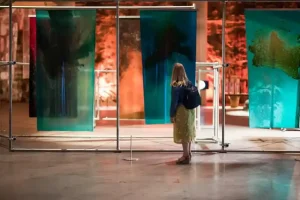

There is a moment in every art lover’s life when they walk into a gallery, squint at a painting, and wonder ,is this modern or contemporary? Both words get thrown around at openings, in museum brochures, and by critics who assume everyone already knows the difference. But here is the truth: most people do not. And that confusion is not your fault. The art world has spent decades using these two terms almost interchangeably, even though they point to completely different eras, philosophies, and exhibition experiences. Understanding what separates modern art exhibits from contemporary exhibitions does not just make you sound smarter at gallery openings. It completely changes how you experience and emotionally connect with the art hanging in front of you.
The Timeline Problem Nobody Talks About
Most people assume “modern” means recent. In everyday language, it does. But in the art world, modern art refers to a very specific historical period ,roughly from the 1860s through the 1970s. This is where the confusion starts. When a museum advertises a modern art exhibit, they are not showing you what was made last year. They are inviting you into a world of Picasso, Matisse, Mondrian, and Pollock ,artists who shattered the rules of Western classical tradition and built something raw, experimental, and deeply human in its place.
Contemporary exhibitions, on the other hand, feature work made from roughly the 1970s or 1980s to the present day. These shows are rooted in the now. They reflect today’s politics, anxieties, technologies, and cultural conversations. The timeline matters because it shapes everything ,the curatorial approach, the themes explored, the audience being addressed, and even the physical way the work is displayed.
Art historians and curators draw this line carefully. Dr. Terry Smith, one of the leading scholars on contemporary art, has argued that contemporary art is not simply “art made recently” but rather art that engages with the condition of contemporaneity ,the shared experience of living in a globalized, digitally saturated, politically fractured present. That is a very different thing from art made in 1932, no matter how groundbreaking it was at the time.
What Defines a Modern Art Exhibit
The Movements That Built the Modern World
Modern art exhibits are essentially curated journeys through a century of revolutionary thinking. The movements that define this era ,Impressionism, Cubism, Expressionism, Surrealism, Abstract Expressionism, and Minimalism ,each represent a radical break from what came before. When you walk into a modern art exhibit, you are walking into the aftermath of multiple artistic rebellions.
Impressionism broke from the tradition of precise academic painting. The Cubists fractured perspective itself. The Surrealists plunged into the unconscious. The Abstract Expressionists turned the physical act of painting into the subject of painting. Each of these movements emerged from specific social and intellectual conditions ,two World Wars, the rise of psychoanalysis, industrialization, mass media, and the collapse of colonial certainties. Modern art exhibits do not just display the objects. The best ones contextualize these upheavals so you feel the weight of the historical moment that produced each canvas.
How Modern Art Exhibits Are Structured
Modern art exhibits tend to follow a more traditional curatorial model. Works are often organized chronologically or by movement, with explanatory wall text that grounds each piece in its historical context. There is a linear logic to many of these shows. You enter, you move through time, and you exit with a clearer understanding of how one artistic idea led to the next.
The lighting in modern art exhibits is typically warm and controlled, designed to flatter oil paint and canvas. Sculptures sit on pedestals. Photographs are framed. The relationship between the viewer and the art is respectful ,even reverential. There is a sense that these objects carry tremendous cultural weight, and the exhibition design honors that. Expert curators spend years building these shows, selecting works that tell a coherent story rather than simply displaying whatever is available.
The Emotional Register of Modern Art
Here is something that gets overlooked: modern art, despite being “historical,” can hit you harder emotionally than almost anything else in a museum. Standing in front of Guernica or a late Rothko is not an intellectual exercise. It is a visceral, sometimes destabilizing experience. The artists of the modern era were processing catastrophic events ,wars, genocide, existential dread ,and they did it without irony. That sincerity is part of what makes modern art exhibits so powerful even a century later.
Key characteristics you will notice in a well-curated modern art exhibit:
-
A clear narrative arc organized around movements, periods, or artistic relationships
-
Contextual wall text that situates each work historically and philosophically
-
A mix of mediums ,oil on canvas, sculpture, printmaking, collage ,with traditional presentation formats
-
An emphasis on individual artistic genius and the biography of the artist
-
Works from established institutional collections or significant private loans
What Defines a Contemporary Exhibition
No Rules, No Boundaries, No Apologies
Contemporary exhibitions operate from an entirely different premise. Where modern art exhibits often celebrate mastery and historical significance, contemporary shows tend to interrogate both. The artists working today have inherited not just the innovations of modernism but also the postmodern critique of those innovations. They know that the “genius artist” narrative was often used to exclude women, artists of color, and non-Western practitioners. Contemporary exhibitions frequently address this inheritance directly.
The range of what qualifies as “art” in a contemporary exhibition is staggeringly broad. You might encounter a room flooded with light that you can walk through. You might encounter a video installation that runs for six hours. You might encounter a sculpture made from your own medical data or a performance that unfolds over three days. The medium is not just a vehicle for expression ,it is part of the meaning.
Immersion, Interaction, and the Dissolving of Distance
One of the most significant differences between modern art exhibits and contemporary exhibitions is the relationship between the viewer and the artwork. Modern art generally maintains a respectful distance. Contemporary art frequently collapses it. Many contemporary exhibitions are designed to be immersive ,you do not look at the art, you move through it, respond to it, or even become part of it.
Think of artists like Olafur Eliasson, whose large-scale installations transform atmospheric experience into aesthetic encounter. Or Yayoi Kusama, whose Infinity Mirror Rooms have drawn millions of visitors who are not simply viewing art but inhabiting it. This shift toward immersion is not accidental. It reflects a broader philosophical move in contemporary art toward relational aesthetics ,the idea, developed by theorist Nicolas Bourriaud, that art should produce and facilitate human relationships rather than simply represent the world.
Social, Political, and Technological Urgency
Contemporary exhibitions are almost always in conversation with the present moment. Climate crisis, racial justice, gender identity, artificial intelligence, migration, surveillance ,these are not background themes. They are front and center. An artist like Kara Walker uses silhouette and shadow to confront the history of American slavery. Trevor Paglen photographs secret government surveillance infrastructure. Hito Steyerl makes films that dissect the economics and politics of images themselves.
This urgency gives contemporary exhibitions a different emotional texture than modern art exhibits. Walking through a contemporary show, you are not being asked to appreciate a historical achievement. You are being asked to feel implicated in the world being described. That can be uncomfortable. It is meant to be.
What to expect in a thoughtfully assembled contemporary exhibition:
-
Works in diverse and often unexpected mediums ,video, sound, performance, digital art, installation, social practice
-
Themes rooted in current cultural, political, and social discourse
-
Interactive or immersive elements that blur the line between viewer and participant
-
A curatorial approach that often challenges traditional notions of authorship and value
-
A deliberately non-linear or open-ended viewing experience
The Role of the Curator in Contemporary Shows
The curator of a contemporary exhibition is not just an organizer ,they are often a co-author of meaning. Contemporary curation is a creative practice in its own right. Curators like Hans Ulrich Obrist have become cultural figures as prominent as many of the artists they champion. The contemporary curator does not just select and arrange works. They develop conceptual frameworks, commission new pieces, and sometimes design the spatial experience of the show from scratch. This level of curatorial authorship is less common in modern art exhibits, where the historical record provides more structural guidance.
The Institutional Divide
Museums themselves are organized around this distinction. The Museum of Modern Art (MoMA) in New York was founded in 1929 specifically to champion the modernist tradition. Its collection runs roughly from Post-Impressionism through the late twentieth century. The New Museum, also in New York, focuses exclusively on contemporary work. Many major institutions maintain separate wings or curatorial departments for each category, acknowledging that they require fundamentally different approaches.
This institutional divide also affects funding, audience development, and critical reception. Modern art exhibits attract audiences who want depth, context, and historical grounding. Contemporary exhibitions attract audiences who want provocation, novelty, and cultural currency. Neither instinct is wrong. They simply reflect different desires from an art experience.
Why the Distinction Matters More Than Ever
In an era of Instagram galleries, AI-generated art, and NFT exhibitions, understanding the difference between modern art exhibits and contemporary exhibitions has taken on new stakes. The art market, the museum world, and the broader culture are all grappling with questions about value, authenticity, and meaning that have their roots in the modernist tradition but are being answered ,or deliberately unanswered ,by contemporary practitioners.
When you understand that Picasso was radical in 1907 and that today’s radical is likely a queer artist from Lagos working in augmented reality, you begin to see art history as a living conversation rather than a fixed canon. That shift in perspective makes every gallery visit richer and every exhibition more legible.
The distinction also matters commercially. Works from the modern period are among the most expensive objects ever sold at auction. A Modigliani or a Basquiat can fetch tens of millions of dollars precisely because their historical position is established and their cultural significance is not in dispute. Contemporary art carries a different kind of risk ,and a different kind of possibility. Collecting it, supporting it, or simply paying attention to it is a bet on what will matter to future generations.
Final Thought
The gap between modern art exhibits and contemporary exhibitions is not just a matter of dates on a timeline. It is a difference in philosophy, intention, emotional register, and relationship to the viewer. Modern art asks you to honor the weight of history. Contemporary art asks you to sit with the discomfort of the present. Both demands are legitimate. Both experiences are irreplaceable. The most engaged art lover is the one who can walk into either kind of exhibition, leave their assumptions at the door, and let the work do what only art can ,pull something into focus that was always there but never quite seen.